
RUSBMT Registry Platform for HSCT and CAR-T Monitoring
About the project
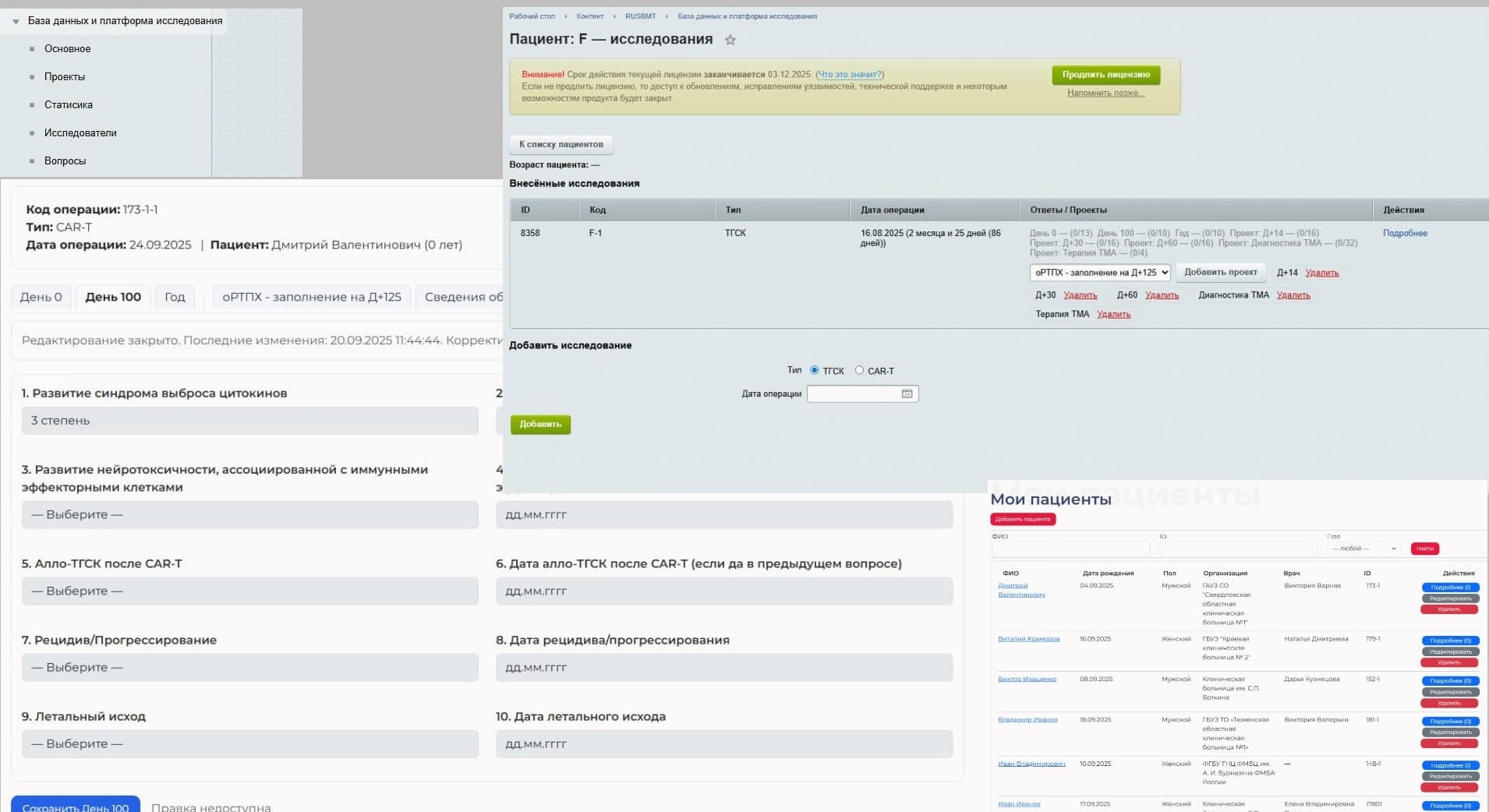
A unified registry platform has been developed for monitoring hematopoietic stem cell transplantation (HSCT), gene and cell therapy (CAR-T). The system combines patient data from different centers, supports two roles - Administrator and Researcher - and allows you to keep records of transplantations, fill out MED forms, connect patients to research projects (for example, GVHD), collect aggregated statistics and make standardized data downloads for subsequent analysis.
Business problem
- Create a single registry web platform for monitoring HSCT, CAR-T and other interventions across the entire network of centers.
- Provide convenient user registration with confirmation by the administrator and differentiation of roles (Administrator/Researcher).
- Organize centralized management of patient records with unique codes and history of interventions.
- Implement MED data entry using standard forms (D0, D+100, annual forms) and by projects (for example, GVHD: D+180, annual forms).
- Create convenient mechanisms for downloading data in a format for statistics and research (including for individual projects).
- Add a statistics block for registration centers and automatic notifications about the need to fill out forms.
Technical solution
- Two main roles: Administrator (central office) and Researcher (field centers) with different levels of access to data.
- Authorization page with the ability to register and recover your password.
- User registration: full name, city and center from drop-down lists, department, position, telephone, e-mail and password; confirmation of registration by the administrator upon application.
- Home page with the RUSBMT logo and the name of the register, as well as instructions for working with the platform in PDF format.
- Section “Patients” with filters by last name, diagnosis and month of registration and a table with a list of patients.
- A unique patient code, generated from the center code and the serial number of the patient in this center (for example, center No. 5, patient No. 32 → code 532).
- Adding a patient: full name, date of birth, gender, selecting the type of intervention (HSCT / CAR-T) and filling out the basic form D0 through the built-in forms.
- Patient card with tabs: “General Information”, “MED” and “Projects”.
- In the MED tab there is a list of all HSCT/CAR-T for the patient with access to the already entered data and the buttons “Fill out the form for D+100” and “Fill out the annual form”.
- Restriction: form D+100 can be filled out only once, annual forms can be filled out multiple times.
- Reminder system: e-mail and notifications in your personal account that it is time to fill out the next form.
- Button “Add HSCT/CAR-T” to register new interventions linked to a patient and a unique intervention code (patient code + serial number).
- “Projects” tab: adding a patient to a project (the first project is GVHD) with the choice of a specific intervention to which the project will be linked, and project forms (D+180, annual forms).
- Export patient data in Excel/CSV format, including the option of general MED upload and upload of data for a specific project.
- Admin panel: overview of all patients by unique codes (without full name), “Statistics” and “Upload” tabs.
- Statistics section: indicators “Patients registered”, “Allogeneic / Autologous transplants registered”, “CAR-T registered”, “Users registered”, as well as a table by center.
- Flexible upload system for administrative and research tasks.
Technologies
- Web application: client + server with authorization and user roles
- Relational database for storing patients, interventions and projects
- Export data to Excel/CSV for statistics and research
- E-mail notification module and internal notification system
Results
- A single register has been created for monitoring HSCT and CAR-T, available to all connected centers.
- The processes of patient registration and MED data entry have been standardized, and scattered Excel tables have been eliminated.
- The preparation of statistics and reporting on centers and projects has been simplified due to ready-made downloads.
- Research teams received a convenient tool for conducting projects (for example, GVHD) and long-term follow-up of patients.
- Due to notifications, the risk of missing checkpoints (D+100, D+180, annual forms) is reduced.
Need the same project?
Leave a request - we will evaluate the problem for free and offer the best solution within 24 hours
150+completed projects
24hproject evaluation
95%customers are returning
Customer review
“The registry has finally allowed us to centralize transplant and CAR-T data from different centers. It has become easier to manage projects, control the deadlines for filling out forms and prepare reports on the country.”